Handmade In Japan Samurai Sword Video Free Download
| Katana ( 刀 ) | |
|---|---|
 A katana modified from a tachi forged by Motoshige. Bizen Osafune schoolhouse influenced by the Sōshū school. 14th century, Nanboku-chō period. Important Cultural Property. Tokyo National Museum. | |
| Blazon | Sword |
| Identify of origin | Japan |
| Service history | |
| Used by | Samurai, Onna-musha, Ninja, Kendo, Iaido practitioners |
| Production history | |
| Produced | Nanboku-chō period (1336-1392) which corresponds to the early Muromachi menses (1336–1573)[1] to present |
| Specifications | |
| Mass | 1.i–1.5 kg |
| Blade length | Approx. 60–80 cm (23.62–31.five in) |
| | |
| Blade type | Curved, single-edged |
| Hilt blazon | Two-handed swept, with round or squared baby-sit |
| Scabbard/sheath | Lacquered wood, some are covered with fish peel, decorated with contumely and copper.[2] [3] |
A katana ( 刀 or かたな or カタナ ) is a Japanese sword characterized past a curved, single-edged blade with a circular or squared guard and long grip to accommodate two hands. Developed later than the tachi, it was used by samurai in feudal Japan and worn with the border facing up. Since the Muromachi catamenia, many old tachi were cut from the root and shortened, and the bract at the root was crushed and converted into katana.[4] The official term for katana in Japan is uchigatana (打刀) and the term katana (刀) often refers to single-edged swords from effectually the globe.[5]
Etymology and loanwords [edit]

The word katana get-go appears in Japanese in the Nihon Shoki of 720. The term is a chemical compound of kata ("one side, 1-sided") + na ("blade"),[vi] [vii] [8] in dissimilarity to the double-sided tsurugi. See more at the Wiktionary entry.
The katana belongs to the nihontō family of swords, and is distinguished past a blade length (nagasa) of more than ii shaku, approximately 60 cm (24 in).[9]
Katana can too exist known as dai or daitō among Western sword enthusiasts, although daitō is a generic name for any Japanese long sword, literally pregnant "big sword".[10]
As Japanese does not accept separate plural and atypical forms, both katanas and katana are considered acceptable forms in English.[11]
Pronounced [katana], the kun'yomi (Japanese reading) of the kanji 刀, originally meaning single edged blade (of whatsoever length) in Chinese, the word has been adopted as a loanword by the Portuguese.[12] In Portuguese the designation (spelled catana) ways "large pocketknife" or machete.[12]
Description [edit]
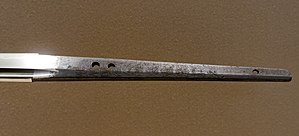
Mei (signature) and Nakago (tang) of an Edo menstruum katana
The katana is more often than not defined as the standard sized, moderately curved (as opposed to the older tachi featuring more curvature) Japanese sword with a blade length greater than 60.6 cm (23.86 inches) (Japanese 2 Shaku).[13] Information technology is characterized past its distinctive advent: a curved, slender, single-edged blade with a round or squared guard (tsuba) and long grip to accommodate 2 easily.[13]
With a few exceptions, katana and tachi tin be distinguished from each other, if signed, past the location of the signature (mei) on the tang (nakago). In general, the mei should exist carved into the side of the nakago which would face outward when the sword was worn. Since a tachi was worn with the cutting edge downward, and the katana was worn with the cutting edge upwards, the mei would be in opposite locations on the tang.[xiv]
Western historians take said that katana were amidst the finest cut weapons in world military machine history.[15] [xvi] However, the chief weapons on the battlefield in the Sengoku period in the 15th century were yumi (bow), yari (spear) and tanegashima (gun), and katana and tachi were used just for close combat. During this period, the tactics changed to a group battle by ashigaru (human foot soldiers) mobilized in large numbers, and then naginata (pole weapon) and tachi became obsolete every bit weapons on the battlefield and were replaced by yari and katana.[17] [18] [nineteen] In the relatively peaceful Edo period, katana increased in importance every bit a weapon, and at the end of the Edo menses, shishi (political activists) fought many battles using katana as their main weapon. Throughout history, katana and tachi were often used as gifts betwixt daimyo (feudal lord) and samurai, or as offerings to the kami enshrined in Shinto shrines, and symbols of authority and spirituality of samurai.[eighteen] [20] [19] [17]
History [edit]
The production of swords in Japan is divided into specific fourth dimension periods:[21]
- Jōkotō (ancient swords, until around 900)
- Kotō (one-time swords from effectually 900–1596)
- Shintō (new swords 1596–1780)
- Shinshintō (newer swords 1781–1876)
- Gendaitō (mod or contemporary swords 1876–present)
Kotō (Onetime swords) [edit]

Masamune forges a katana with an assistant (ukiyo-e)

A Sōshū school katana modified from a tachi forged past Masamune. Every bit it was owned by Ishida Mitsunari, it was usually called Ishida Masamune. Important Cultural Property. Tokyo National Museum


Katana originates from sasuga (刺刀), a kind of tantō (short sword or knife) used by lower-ranking samurai who fought on foot in the Kamakura menses (1185–1333). Their main weapon was a long naginata and sasuga was a spare weapon. In the Nanboku-chō period (1336-1392) which corresponds to the early on Muromachi period (1336-1573), long weapons such equally ōdachi were popular, and forth with this, sasuga diffuse and finally became katana.[22] [23] Also, at that place is a theory that koshigatana (腰刀), a kind of tantō which was equipped by high ranking samurai together with tachi, developed to katana through the same historical background as sasuga, and it is possible that both developed to katana.[24] The oldest katana in existence today is called Hishizukuri uchigatana, which was forged in the Nanbokuchō period, and was dedicated to Kasuga Shrine later.[1]
The outset apply of katana as a give-and-take to draw a long sword that was different from a tachi, occurs as early on as the Kamakura Period.[13] These references to "uchigatana" and "tsubagatana" seem to indicate a different style of sword, maybe a less costly sword for lower-ranking warriors. Starting around the year 1400, long swords signed with the katana-style mei were made. This was in response to samurai wearing their tachi in what is at present chosen "katana style" (cutting edge upwardly). Japanese swords are traditionally worn with the mei facing away from the wearer. When a tachi was worn in the style of a katana, with the cutting edge upwards, the tachi's signature would exist facing the wrong way. The fact that swordsmiths started signing swords with a katana signature shows that some samurai of that fourth dimension period had started wearing their swords in a different manner.[25] [26]
Traditionally, yumi (bows) were the principal weapon of state of war in Japan, and tachi and naginata were used just for close combat. The Ōnin War in the belatedly 15th century in the Muromachi menses expanded into a big-scale domestic state of war, in which employed farmers chosen ashigaru were mobilized in big numbers. They fought on pes using katana shorter than tachi. In the Sengoku menstruation (period of warring states) in the late Muromachi menstruation, the war became bigger and ashigaru fought in a shut formation using yari (spears) lent to them. Furthermore, in the late 16th century, tanegashima (muskets) were introduced from Portugal, and Japanese swordsmiths mass-produced improved products, with ashigaru fighting with leased guns. On the battlefield in Japan, guns and spears became main weapons in add-on to bows. Due to the changes in fighting styles in these wars, the tachi and naginata became obsolete among samurai, and the katana, which was piece of cake to carry, became the mainstream. The dazzling looking tachi gradually became a symbol of the authority of high-ranking samurai.[22] [20] [19]
On the other hand, kenjutsu (swordsmanship) that makes use of the characteristics of katana was invented. The quicker depict of the sword was well suited to gainsay where victory depended heavily on short response times. (The practice and martial art for cartoon the sword chop-chop and responding to a sudden set on was called Battōjutsu, which is still kept live through the education of Iaido.) The katana farther facilitated this by being worn thrust through a chugalug-like sash (obi) with the sharpened border facing upwards. Ideally, samurai could describe the sword and strike the enemy in a single motion. Previously, the curved tachi had been worn with the edge of the blade facing down and suspended from a belt.[xiii] [27]
From the 15th century, low-quality swords were mass-produced nether the influence of the big-scale state of war. These swords, along with spears, were lent to recruited farmers called ashigaru and swords were exported. Such mass-produced swords are called kazuuchimono, and swordsmiths of the Bisen school and Mino school produced them by division of labor.[22] [28] The consign of katana and tachi reached its elevation during this period, from the late 15th century to early on 16th century when at least 200,000 swords were shipped to Ming Dynasty China in official trade in an attempt to soak up the production of Japanese weapons and go far harder for pirates in the expanse to arm. In the Ming Dynasty of Mainland china, Japanese swords and their tactics were studied to repel pirates, and wodao and miaodao were developed based on Japanese swords.[2] [29] [30]
From this menstruation, the tang (nakago) of many old tachi were cut and shortened into katana. This kind of remake is called suriage (磨上げ).[four] For case, many of the tachi that Masamune forged during the Kamakura menstruation were converted into katana, so his only existing works are katana and tantō.[31]

From the late Muromachi period (Sengoku period) to the early Edo menstruum, samurai were sometimes equipped with a katana bract pointing downward like a tachi. This style of sword is called handachi, "half tachi". In handachi, both styles were often mixed, for example, fastening to the obi was katana style, just metalworking of the scabbard was tachi style.[32]
In the Muromachi flow, especially the Sengoku period, people such as farmers, townspeople, and monks could have a sword. However, in 1588 Toyotomi Hideyoshi banned farmers from owning weapons and conducted a sword hunt to forcibly remove swords from anyone identifying as a farmer.[24]
The length of the katana bract varied considerably during the class of its history. In the late 14th and early 15th centuries, katana blades tended to have lengths between 70 and 73 centimetres (28 and 29 in). During the early 16th century, the boilerplate length dropped near 10 centimetres (3.9 in), approaching closer to 60 centimetres (24 in). Past the late 16th century, the average length had increased again by about thirteen centimetres (5.1 in), returning to approximately 73 centimetres (29 in).[27]
Shintō (New swords) [edit]

Antique Japanese daishō, the traditional pairing of two Japanese swords which were the symbol of the samurai, showing the traditional Japanese sword cases (koshirae) and the difference in size between the katana (bottom) and the smaller wakizashi (height).
Swords forged later on 1596 in the Keichō menstruation of the Azuchi–Momoyama period are classified every bit shintō (New swords). Japanese swords subsequently shintō are different from kotō in forging method and steel (tamahagane). This is thought to exist because Bizen school, which was the largest swordsmith group of Japanese swords, was destroyed by a great alluvion in 1590 and the mainstream shifted to Mino school, and considering Toyotomi Hideyoshi virtually unified Japan, uniform steel began to be distributed throughout Japan. The kotō swords, especially the Bizen schoolhouse swords made in the Kamakura menstruation, had a midare-utsuri like a white mist betwixt hamon and shinogi, merely in the swords later on shintō information technology has most disappeared. In addition, the whole body of the blade became whitish and hard. Almost no ane was able to reproduce midare-utsurii until Kunihira Kawachi reproduced it in 2014.[33] [34]

Sword fittings. Tsuba (pinnacle left) and fuchigashira (top right) made by Ishiguro Masayoshi in the 18th or 19th century. Kogai (middle) and kozuka (lesser) made past Yanagawa Naomasa in the 18th century, Edo menses. Tokyo Fuji Art Museum.
As the Sengoku period (flow of warring states) ended and the Azuchi-Momoyama flow to the Edo period started, katana-forging also adult into a highly intricate and well-respected fine art class. Lacquered saya (scabbards), ornate engraved fittings, silk handles and elegant tsuba (handguards) were pop amid samurai in the Edo Period, and somewhen (especially when Nippon was in peace time), katana became more than corrective and ceremonial items than practical weapons.[35] The Umetada school led past Umetada Myoju who was considered to be the founder of shinto led the improvement of the artistry of Japanese swords in this menstruum. They were both swordsmiths and metalsmiths, and were famous for carving the blade, making metal accouterments such as tsuba (handguard), remodeling from tachi to katana (suriage), and inscriptions inlaid with gold.[36]
During this period, the Tokugawa shogunate required samurai to wear Katana and shorter swords in pairs. These brusk swords were wakizashi and tantō, and wakizashi were mainly selected. This set of ii is chosen a daishō. Just samurai could clothing the daishō: it represented their social power and personal honour.[xiii] [27] [37] Samurai could wear decorative sword mountings in their daily lives, just the Tokugawa shogunate regulated the formal sword that samurai wore when visiting a castle past regulating information technology as a daisho fabricated of a black scabbard, a hilt wrapped with white ray pare and blackness string.[38] Japanese swords made in this period are classified as shintō.[39]
Shinshintō (New new swords) [edit]

Daishō (Katana and Wakizashi) forged by Minamoto no Kiyomaro. 1848, Late Edo menstruum. (non to scale)
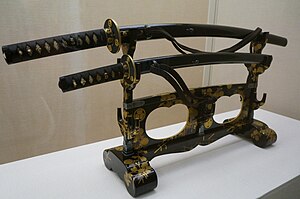
Daishō for formal attire with black scabbard, hilt winding thread and white ray skin hilt, which were regulated by the Tokugawa Shogunate. Daishō owned by Uesugi clan. Late Edo period.
In the late 18th century, swordsmith Suishinshi Masahide criticized that the present katana blades only emphasized decoration and had a problem with their toughness. He insisted that the assuming and strong kotō blade from the Kamakura period to the Nanboku-chō flow was the ideal Japanese sword, and started a movement to restore the production method and use information technology to Katana. Katana made after this is classified every bit a shinshintō.[39] One of the most popular swordsmiths in Japan today is Minamoto Kiyomaro who was active in this shinshintō period. His popularity is due to his timeless infrequent skill, as he was nicknamed "Masamune in Yotsuya" after his disastrous life. His works were traded at high prices and exhibitions were held at museums all over Japan from 2013 to 2014.[40] [41] [42]
The idea that the blade of a sword in the Kamakura period is the best has been continued until at present, and as of the 21st century, 80% of Japanese swords designated as National treasure in Japan were made in the Kamakura period, and seventy% of them were tachi.[43] [44]
The arrival of Matthew Perry in 1853 and the subsequent Convention of Kanagawa caused chaos in Japanese club. Conflicts began to occur frequently between the forces of sonnō jōi (尊王攘夷派), who wanted to overthrow the Tokugawa Shogunate and dominion by the Emperor, and the forces of sabaku (佐幕派), who wanted the Tokugawa Shogunate to continue. These political activists, called the shishi (志士), fought using a practical katana, called the kinnōtō (勤皇刀) or the bakumatsutō (幕末刀). Their katana were often longer than 90 cm (35.43 in) in blade length, less curved, and had a large and precipitous betoken, which was advantageous for stabbing in indoor battles.[39]
Gendaitō (Modern or contemporary swords) [edit]
Meiji – World State of war Ii [edit]

Although the number of forged swords decreased in the Meiji period, many artistically first-class mountings were made. A wakizashi forged by Soshu Akihiro. Nanboku-chō menstruation. (top) Wakizashi mounting, Early on Meiji period. (bottom)
During the Meiji period, the samurai course was gradually disbanded, and the special privileges granted to them were taken away, including the correct to deport swords in public. The Haitōrei Edict in 1876 forbade the carrying of swords in public except for sure individuals, such as former samurai lords (daimyō), the military machine, and the constabulary.[45] Skilled swordsmiths had trouble making a living during this period as Japan modernized its military machine, and many swordsmiths started making other items, such as farm equipment, tools, and cutlery. The craft of making swords was kept alive through the efforts of some individuals, notably Miyamoto Kanenori (宮本包則, 1830–1926) and Gassan Sadakazu (月山貞一, 1836–1918), who were appointed Imperial Household Creative person. The businessman Mitsumura Toshimo (光村利藻, 1877-1955)tried to preserve their skills by ordering swords and sword mountings from the swordsmiths and craftsmen. He was especially enthusiastic about collecting sword mountings, and he collected virtually 3,000 precious sword mountings from the finish of the Edo period to the Meiji period. Nigh 1200 items from a office of his collection are now in the Nezu Museum.[46] [47] [48]
Military action by Japan in China and Russia during the Meiji menstruation helped revive interest in swords, but it was not until the Shōwa catamenia that swords were produced on a large scale over again.[49] Japanese military swords produced between 1875 and 1945 are referred to every bit guntō (military swords).[fifty]

During the pre-World War II military buildup, and throughout the war, all Japanese officers were required to wear a sword. Traditionally fabricated swords were produced during this period, but in club to supply such large numbers of swords, blacksmiths with fiddling or no knowledge of traditional Japanese sword manufacture were recruited. In improver, supplies of the Japanese steel (tamahagane) used for swordmaking were limited, so several other types of steel were also used. Quicker methods of forging were also used, such equally the employ of power hammers, and quenching the blade in oil, rather than mitt forging and water. The non-traditionally made swords from this menstruation are chosen shōwatō, later the regnal name of the Emperor Hirohito, and in 1937, the Japanese government started requiring the utilise of special stamps on the tang (nakago) to distinguish these swords from traditionally fabricated swords. During this period of war, older antique swords were remounted for use in military mounts. Presently, in Japan, shōwatō are not considered to be "true" Japanese swords, and they can be confiscated. Outside Japan, however, they are nerveless as historical artifacts.[45] [49] [51]
Post-World War II [edit]

Japanese girl practicing iaidō with a mod training katana or iaitō. This sword was custom-made in Nippon to suit the weight and size of the educatee. The blade is made of aluminum alloy and lacks a sharp edge for safety reasons.
Between 1945 and 1953, sword manufacture and sword-related martial arts were banned in Japan. Many swords were confiscated and destroyed, and swordsmiths were not able to brand a living. Since 1953, Japanese swordsmiths have been allowed to work, only with severe restrictions: swordsmiths must be licensed and serve a five-year apprenticeship, and only licensed swordsmiths are immune to produce Japanese swords (nihonto), only two longswords per month are allowed to be produced by each swordsmith, and all swords must be registered with the Japanese Authorities.[52]
Outside Nippon, some of the modern katanas beingness produced by western swordsmiths apply modern steel alloys, such as L6 and A2. These modern swords replicate the size and shape of the Japanese katana and are used by martial artists for iaidō and fifty-fifty for cutting exercise (tameshigiri).
Mass-produced swords including iaitō and shinken in the shape of katana are available from many countries, though China dominates the market.[53] These types of swords are typically mass-produced and made with a broad variety of steels and methods.
Co-ordinate to the Parliamentary Association for the Preservation and Promotion of Japanese Swords, organized by Japanese Diet members, many katana distributed around the world as of the 21st century are imitation Japanese swords made in China. The Sankei Shimbun analyzed that this is considering the Japanese authorities allowed swordsmiths to brand only 24 Japanese swords per person per year in order to maintain the quality of Japanese swords.[54] [55]
Many swordsmiths later the Edo period take tried to reproduce the sword of the Kamakura period which is considered as the best sword in the history of Japanese swords, but they have failed. So, in 2014, Kunihira Kawachi succeeded in reproducing information technology and won the Masamune Prize, the highest accolade equally a swordsmith. No one could win the Masamune Prize unless he fabricated an extraordinary achievement, and in the section of tachi and katana, no one had won for 18 years before Kawauchi.[34]
Types [edit]
Katana are distinguished by their type of blade:
- Shinogi-Zukuri is the nearly common blade shape for Japanese katana that provides both speed and cutting power. It features a distinct yokote: a line or bevel that separates the finish of the main bract and the finish of the tip. Shinogi-zukuri was originally produced later the Heian period.
- Shobu-Zukuri is a variation of shinogi-zukuri without a yokote, the distinct angle between the long cutting border and the point department. Instead, the border curves smoothly and uninterrupted into the betoken.
- Kissaki-Moroha-Zukuri is a katana blade shape with a distinctive curved and double-edged blade. One edge of the bract is shaped in normal katana fashion while the tip is symmetrical and both edges of the bract are precipitous.
Forging and construction [edit]

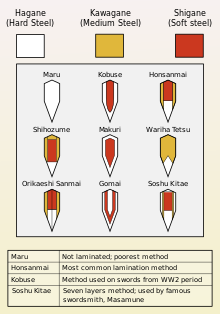
Cross sections of Japanese sword blade lamination methods
Typical features of Japanese swords represented by katana and tachi are a 3-dimensional cross-sectional shape of an elongated pentagonal to hexagonal blade called shinogi-zukuri, a style in which the blade and the tang (nakago) are integrated and stock-still to the hilt (tsuka) with a pin chosen mekugi, and a gentle curve. When a shinogi-zukuri sword is viewed from the side, there is a ridge line of the thickest part of the blade called shinogi between the cutting-edge side and the dorsum side. This shinogi contributes to lightening and toughening of the blade and high cutting power.[56]
Katana are traditionally made from a specialized Japanese steel called tamahagane,[57] which is created from a traditional smelting process that results in several, layered steels with different carbon concentrations.[58] This process helps remove impurities and even out the carbon content of the steel. The age of the steel plays a role in the ability to remove impurities, with older steel having a higher oxygen concentration, being more easily stretched and rid of impurities during hammering, resulting in a stronger blade.[59] The smith begins by folding and welding pieces of the steel several times to piece of work out most of the differences in the steel. The resulting block of steel is then drawn out to form a barracks.
At this stage, it is just slightly curved or may accept no curve at all. The katana's gentle curvature is attained by a process of differential hardening or differential quenching: the smith coats the blade with several layers of a wet clay slurry, which is a special concoction unique to each sword maker, simply more often than not composed of clay, h2o and any or none of ash, grinding rock powder, or rust. This process is called tsuchioki. The edge of the blade is coated with a thinner layer than the sides and spine of the sword, heated, and so quenched in water (few sword makers employ oil to quench the blade). The slurry causes simply the blade's border to exist hardened and likewise causes the blade to curve due to the divergence in densities of the micro-structures in the steel.[27] When steel with a carbon content of 0.7% is heated beyond 750 °C, information technology enters the austenite phase. When austenite is cooled very all of a sudden by quenching in h2o, the structure changes into martensite, which is a very difficult course of steel. When austenite is allowed to cool slowly, its structure changes into a mixture of ferrite and pearlite which is softer than martensite.[lx] [61] This process likewise creates the distinct line downwards the sides of the blade called the hamon, which is made distinct by polishing. Each hamon and each smith's fashion of hamon is distinct.[27]
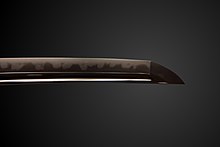
Subsequently the blade is forged, it is then sent to be polished. The polishing takes between ane and 3 weeks. The polisher uses a series of successively finer grains of polishing stones in a process called glazing, until the bract has a mirror cease. Withal, the blunt border of the katana is often given a matte finish to emphasize the hamon.[27]
Japanese swords are by and large fabricated by a segmentation of labor between six and eight craftsmen. Tosho (Toko, Katanakaji) is in charge of forging blades, togishi is in accuse of polishing blades, kinkosi (chokinshi) is in accuse of making metal fittings for sword fittings, shiroganeshi is in charge of making habaki (brade collar), sayashi is in charge of making scabbards, nurishi is in accuse of applying lacquer to scabbards, tsukamakishi is in accuse of making hilt, and tsubashi is in charge of making tsuba (hand guard). Tosho utilise apprentice swordsmiths as assistants. Prior to the Muromachi flow, tosho and kacchushi (armorer) used surplus metallic to make tsuba, merely from the Muromachi period onwards, specialized craftsmen began to make tsuba. Present, kinkoshi sometimes serves as shiroganeshi and tsubashi.[62] [63]
Appreciation [edit]
Historically, katana have been regarded not only as weapons just as well as works of art, especially for high-quality ones. For a long time, Japanese people have developed a unique appreciation method in which the bract is regarded as the core of their aesthetic evaluation rather than the sword mountings decorated with luxurious lacquer or metal works.[64] [65]
It is said that the following three objects are the almost noteworthy objects when appreciating a bract. The first is the overall shape referred to as sugata. Curvature, length, width, tip, and shape of tang of the sword are the objects for appreciation. The 2nd is a fine pattern on the surface of the blade, which is referred to as hada or jigane. By repeatedly folding and forging the blade, fine patterns such equally fingerprints, tree rings and bark are formed on its surface. The third is hamon. Hamon is a white blueprint of the cutting edge produced by quenching and tempering. The object of appreciation is the shape of hammon and the crystal particles formed at the boundary of hammon. Depending on the size of the particles, they tin can be divided into ii types, a nie and a nioi, which makes them await like stars or mist. In add-on to these 3 objects, a swordsmith signature and a file blueprint engraved on tang, and a etching inscribed on the blade, which is referred to every bit horimono, are also the objects of appreciation.[64] [65]
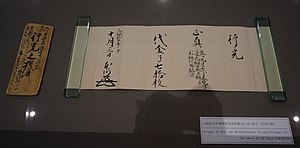
A Japanese sword authentication paper (Origami) from 1702 that Hon'ami Kōchū certified a tantō fabricated by Yukimitsu in the 14th century as accurate.
The Hon'ami association, which was an dominance of appraisement of Japanese swords, rated Japanese swords from these artistic points of view. In addition, experts of mod Japanese swords judge when and by which swordsmith school the sword was fabricated from these creative points of view.[64] [65]
More often than not, the bract and the sword mounting of Japanese swords are displayed separately in museums, and this tendency is remarkable in Japan. For example, the Nagoya Japanese Sword Museum "Nagoya Touken World", one of Nippon's largest sword museums, posts separate videos of the blade and the sword mounting on its official website and YouTube.[66] [67]
Rating of Japanese swords and swordsmiths [edit]
In Japan, Japanese swords are rated by authorities of each menses, and some of the dominance of the rating is however valid today.
In 1719, Tokugawa Yoshimune, the 8th shogun of the Tokugawa shogunate, ordered Hon'ami Kōchū, who was an authority of sword appraisal, to record swords possessed by daimyo all over Japan in books. In the completed "Kyōhō Meibutsu Chō" (享保名物帳) 249 precious swords were described, and additional 25 swords were described afterwards. The list besides includes 81 swords that had been destroyed in previous fires. The precious swords described in this book were called "Meibutsu" (名物) and the criteria for selection were creative elements, origins and legends. The list of "Meibutsu" includes 59 swords made by Masamune, 34 past Awataguchi Yoshimitsu and 22 by Go Yoshihiro, and these three swordsmiths were considered special. Daimyo hid some swords for fear that they would be confiscated by the Tokugawa Shogunate, so even some precious swords were not listed in the volume. For example, Daihannya Nagamitsu and Yamatorige, which are now designated as National Treasures, were not listed.[43]

Katana forged by Nagasone Kotetsu. The letters inlaid with gold on the tang (nakago) indicated that Yamano Kauemon (山野加右衛門), the official executioner of the Tokugawa shogunate and examiner of sword cutting performance, cut the four homo trunk overlapped.[68]
Yamada Asaemon V, who was the official sword cutting ability examiner and executioner of the Tokugawa shogunate, published a book "Kaiho Kenjaku" (懐宝剣尺) in 1797 in which he ranked the cut ability of swords. The book lists 228 swordsmiths, whose forged swords are called "Wazamono" (業物) and the highest "Saijo Ō Wazamono" (最上大業物) has 12 selected. In the reprinting in 1805, one swordsmith was added to the highest form, and in the major revised edition in 1830 "Kokon Kajibiko" (古今鍛冶備考), two swordsmiths were added to the highest course, and in the cease, 15 swordsmiths were ranked as the highest class. The katana forged by Nagasone Kotetsu, one of the meridian-rated swordsmith, became very popular at the time when the book was published, and many counterfeits were made. In these books, the 3 swordsmiths treated specially in "Kyōhō Meibutsu Chō" and Muramasa, who was famous at that fourth dimension for forging swords with high cutting ability, were not mentioned. The reasons for this are considered to be that Yamada was agape of challenging the authority of the shogun, that he could non utilize the precious sword possessed by the daimyo in the test, and that he was considerate of the fable of Muramasa's curse.[43] [69]
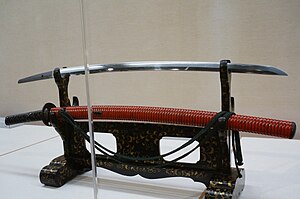
A katana forged past Magoroku Kanemoto. (Saijo Ō Wazamono) Tardily Muromachi menstruum. (acme) Katana mounting, Early Edo menstruum. (lesser)
Now, past the Police force for the Protection of Cultural Backdrop, important swords of loftier historical value are designated as Important Cultural Properties (Jūyō Bunkazai, 重要文化財), and special swords among them are designated as National Treasures (Kokuhō, 国宝). The swords designated as cultural properties based on the law of 1930, which was already abolished, take the rank next to Important Cultural Properties as Of import Art Object (Jūyō Bijutsuhin, 重要美術品). In addition, The Gild for Preservation of Japanese Fine art Swords, a public involvement incorporated foundation, rates high-value swords in iv grades, and the highest form Special Important Sword (Tokubetsu Juyo Token, 特別重要刀剣) is considered to exist equivalent to the value of Important Art Object. Although swords owned by the Japanese Imperial Family are not designated every bit National Treasures or Of import Cultural Properties because they are exterior the jurisdiction of the Police force for the Protection of Cultural Properties, there are many swords of the National Treasure form, and they are chosen "Gyobutsu" (御物).[43] [lxx]
Currently, in that location are several administrative rating systems for swordsmiths. Co-ordinate to the rating approved past the Japanese regime, from 1890 to 1947, two swordsmiths who were appointed every bit Imperial Household Artist and subsequently 1955, vi swordsmiths who were designated every bit Living National Treasure are regarded as the best swordsmiths. According to the rating approved by The Society for Preservation of Japanese Art Swords, a public interest incorporated foundation, 39 swordsmiths who were designated equally Mukansa (無鑑査) since 1958 are considered to exist the highest ranking swordsmiths. The best sword forged past Japanese swordsmiths is awarded the most honorable Masamune prize by The Society for Preservation of Japanese Fine art Swords. Since 1961, 8 swordsmiths accept received the Masamune Prize, and amidst them, three swordsmiths, Masamine Sumitani, Akitsugu Amata and Toshihira Osumi, have received the prize three times each and Sadakazu Gassan II has received the prize ii times. These four people were designated both Living National Treasures and Mukansa.[71]
Usage in martial arts [edit]
Katana were used by samurai both in the battlefield and for practicing several martial arts, and modern martial artists nonetheless utilize a variety of katana. Martial arts in which training with katana is used include iaijutsu, battōjutsu, iaidō, kenjutsu, kendō, ninjutsu and Tenshin Shōden Katori Shintō-ryū. [72] [73] [74] However, for safety reasons, katana used for martial arts are unremarkably edgeless edged, to reduce the run a risk of injury. Sharp katana are only really used during tameshigiri (blade testing), where a practitioner practices cutting a bamboo or tatami straw post.
Storage and maintenance [edit]
If mishandled in its storage or maintenance, the katana may become irreparably damaged. The blade should exist stored horizontally in its sheath, bend downwards and edge facing upward to maintain the border. It is extremely important that the blade remain well-oiled, powdered and polished, as the natural moisture residue from the hands of the user will rapidly cause the blade to rust if non cleaned off. The traditional oil used is chōji oil (99% mineral oil and 1% clove oil for fragrance). Similarly, when stored for longer periods, it is of import that the katana be inspected often and aired out if necessary in guild to prevent rust or mold from forming (mold may feed off the salts in the oil used to smoothen the blade).[75]
World records [edit]
Multiple sword world records were fabricated with a katana and verified by Guinness World Records. Iaido chief Isao Machii set the record for "Near martial arts katana cuts to 1 mat (suegiri)",[76] "Fastest 1,000 martial arts sword cuts",[77] "Nigh sword cuts to straw mats in three minutes",[78] and "Fastest lawn tennis ball (708km/h) cutting by sword".[79] At that place are diverse records for Tameshigiri. For instance the Greek Agisilaos Vesexidis fix the tape for most martial arts sword cuts in i minute (73) on 25 June 2016.[fourscore]
Ownership and trade restrictions [edit]
Ireland [edit]
Under the Firearms and Offensive Weapons Act 1990 (Offensive Weapons) (Amendment) Guild 2009, katanas made post-1953 are illegal unless made past hand co-ordinate to traditional methods.[81]
U.k. [edit]
As of April 2008, the British authorities added swords with a curved blade of 50 cm (20 in) or over in length ("the length of the blade shall be the straight line distance from the height of the handle to the tip of the bract") to the Offensive Weapons Order.[82] This ban was a response to reports that samurai swords were used in more 80 attacks and four killings over the preceding four years.[83] Those who violate the ban would be jailed up to half dozen months and charged a fine of £five,000. Martial arts practitioners, historical re-enactors and others may still own such swords. The sword can too be legal provided information technology was fabricated in Japan before 1954, or was fabricated using traditional sword making methods. It is also legal to purchase if information technology tin exist classed equally a "martial creative person's weapon". This ban applies to England, Wales, Scotland and Northern Ireland. This ban was amended in August 2008 to allow sale and ownership without licence of "traditional" paw-forged katana.[84]
Gallery [edit]
-
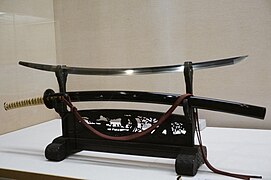
A katana forged by Hizen Tadayoshi I. (Saijo Ō Wazamono) Azuchi-Momoyama period. (tiptop) Katana mounting, Belatedly Edo menstruation. (lesser)
-

Katana style sword mounting with hollyhocks pattern crests in maki-e lacquer and mother of pearl inlay on ikakeji lacuer ground. Edo period, 19th century.
-

Daishō, black waxed scabbards. This daishō is an informal style because the thread wound on the hilt is purple. 19th century, Edo period. Tokyo Fuji Art Museum.
-
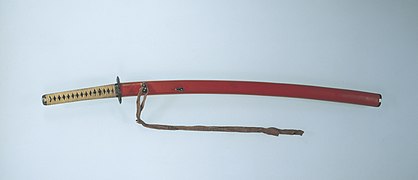
Mounting for a katana forged by Motoshige. late 16th or early 17th century, Azuchi–Momoyama or Edo menstruation. Important Cultural Property. Tokyo National Museum.
-

Japanese katana showing a horimono (blade carving), Metropolitan Museum of Fine art.
-

Hilt of katana. Early on Edo period.
-
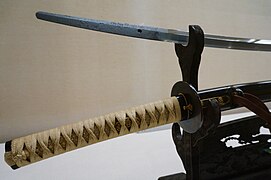
The inscription (mei) on the tang (nakago) of a katana forged by Hizen tadayoshi I, Azuchi-Momoyama period. (top) Hilt of katana. Belatedly Edo period. (lesser)
-

Koshirae (mountings) of an Edo period daishō, rayskin wrapped with silk.
-
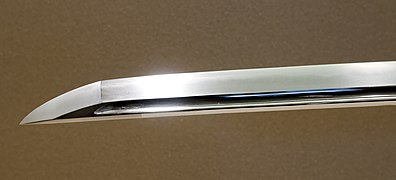
Kissaki (indicate) of an Edo period katana.
Pop culture [edit]
- Katana swords are a common weapon for characters in anime and manga who fight using a sword.
- Two katana swords were the standard weapons of Leonardo in the Teenage Mutant Ninja Turtles franchise. One was also used by Miyamoto Usagi, the virtuous rabbit ronin who occasionally teamed upward with the Ninja Turtles and became a brotherly figure to Leonardo due to both existence swordsmen and valuing honour.
- In Fist of Legend, Full general Fujita uses a katana every bit he tries to kill the primary hero Chen and his mentor Huo.
- In Samurai Jack, the championship graphic symbol wielded a mystic katana sword.
- A katana sword was a standard weapon of Deathstroke, a mercenary from DC Comics.
- A katana sword was used by the Silver Samurai, a samurai crime boss from Marvel Comics.
- A katana sword was used past Samurai Org in Power Rangers Wild Force.
- A katana sword is used by Youmu Konpaku from the Touhou Project video game series.
See besides [edit]
 | Wikimedia Commons has media related to Katana. |
- Kenjutsu
- Iaidō
- Japanese sword mountings
- Japanese sword
- Daishō
- Ōdachi
- Tachi
- Wakizashi
- Tenka-Goken (Five Swords nether Sky) - v individual swords traditionally viewed as the best Japanese swords
- Backsword
- Broadsword
- Japanese swords in fiction
- Korean sword
References [edit]
- ^ a b Kazuhiko Inada (2020), Encyclopedia of the Japanese Swords. p43. ISBN 978-4651200408
- ^ a b Takeo Tanaka. (2012) Wokou p.104. Kodansha. ISBN 978-4062920933
- ^ "日本の技術の精巧さは…". Mainichi Shimbun. 27 March 2016. Archived from the original on 28 August 2016.
- ^ a b 日本刀鑑賞のポイント「日本刀の姿」 Nagoya Touken Museum Touken World
- ^ 日本刀と刀の違い Nagoya Japanese Sword Museum Touken World
- ^ 1988, 国語大辞典(新装版) (Kokugo Dai Jiten, Revised Edition) (in Japanese), Tōkyō: Shogakukan, 刀 ( katana ) entry available online hither
- ^ 2006, 大辞林 (Daijirin), Tertiary Edition (in Japanese), Tōkyō: Sanseidō, ISBN iv-385-13905-9
- ^ 1995, 大辞泉 (Daijisen) (in Japanese), Tōkyō: Shogakukan, ISBN iv-09-501211-0, 刀 ( katana ) entry available online here
- ^ "How Long Is a Katana?". Medieval Swords World. iii August 2019. Retrieved ix September 2019.
- ^ Sun-Jin Kim (1996). Tuttle Dictionary Martial Arts Korea, China & Japan. Tuttle Publishing. p. 61. ISBN978-0-8048-2016-5.
- ^ Adrian Akmajian; Richard A. Demers; Ann K. Farmer; Robert M. Harnish (2001). Linguistics: An Introduction to Linguistic communication and Communication. Massachusetts: The MIT Press. p. 624. ISBN9780262511230.
- ^ a b Sebastião Rodolfo Dalgado; Anthony X. Soares (1988). Portuguese Vocables in Asiatic Languages: From the Portuguese Original of Monsignor Sebastiao Rodolfo Dalgado. S Asia Books. p. 520. ISBN978-81-206-0413-1.
- ^ a b c d due east Kanzan Sato (1983). The Japanese Sword: A Comprehensive Guide (Japanese arts Library). Nihon: Kodansha International. p. 220. ISBN978-0-87011-562-2.
- ^ 土子民夫 (May 2002). 日本刀21世紀への挑戦. Kodansha International. p. xxx. ISBN978-4-7700-2854-9.
- ^ Roger Ford (2006). Weapon: A Visual History of Artillery and Armor. DK Publishing. pp. 66, 120. ISBN9780756622107.
- ^ Anthony J. Bryant and Angus McBride (1994) Samurai 1550–1600. Osprey Publishing. p. 49. ISBN 1855323451
- ^ a b Kazuhiko Inada (2020), Encyclopedia of the Japanese Swords. p42. ISBN 978-4651200408
- ^ a b 歴史人 September 2020. pp.40-43. ASIN B08DGRWN98
- ^ a b c Artillery for battle - spears, swords, bows. Nagoya Japanese Sword Museum Touken Earth
- ^ a b History of Japanese swords "Muromachi period - Azuchi-Momoyama period". Nagoya Japanese Sword Museum Touken World
- ^ Transition of kotō, shintō, shinshintō, and gendaitō. Nagoya Japanese Sword Museum Touken World
- ^ a b c 歴史人 September 2020. p40. ASIN B08DGRWN98
- ^ List of terms related to Japanese swords "Sasuga". Nagoya Japanese Sword Museum Touken World.
- ^ a b Differences in Japanese swords according to condition. Nagoya Japanese Sword Museum Touken Globe.
- ^ Stephen Turnbull (eight February 2011). Katana: The Samurai Sword. Osprey Publishing. pp. 22–. ISBN978-1-84908-658-5.
- ^ Kōkan Nagayama (1997). The Connoisseur's Book of Japanese Swords. Kodansha International. p. 28. ISBN978-4-7700-2071-0.
- ^ a b c d e f Leon Kapp; Hiroko Kapp; Yoshindo Yoshihara (1987). The Arts and crafts of the Japanese Sword. Nihon: Kodansha International. p. 167. ISBN978-0-87011-798-5.
- ^ 歴史人 September 2020. pp.70-71. ASIN B08DGRWN98
- ^ Koichi Shinoda. (1 May 1992). Chinese Weapons and Armor. Shinkigensha. ISBN 9784883172115
- ^ Rekishi Gunzo. (2 July 2011) Complete Works on Strategic and Tactical Weapons. From Ancient China to Modernistic China. Gakken. ISBN 9784056063448
- ^ 相州伝の名工「正宗」. Nagoya Japanese Sword Museum Touken Globe.
- ^ weblio. Handachi-Goshirae.
- ^ History of Japanese sword. Nagoya Japanese Sword Museum Touken World
- ^ a b 日本刀鑑賞のポイント「日本刀の映りとは」. Nagoya Japanese Sword Museum Touken World
- ^ Masayuki Murata. 明治工芸入門 p.120. Me no Me, 2017 ISBN 978-4907211110
- ^ 特別展「埋忠〈UMETADA〉桃山刀剣界の雄」. Internet Museum
- ^ Oscar Ratti; Adele Westbrook (1991). Secrets of the Samurai: The Martial Arts of Feudal Japan. Tuttle Publishing. p. 484. ISBN978-0-8048-1684-7.
- ^ Kazuhiko Inada (2020), Encyclopedia of the Japanese Swords. p46. ISBN 978-4651200408
- ^ a b c 歴史人 September 2020. pp.42-43. ASIN B08DGRWN98
- ^ 幕末に活躍した日本刀の名工「清麿」展=ダイナミックな切っ先、躍動感あふれる刃文. Jiji Press
- ^ 清麿展 -幕末の志士を魅了した名工- Internet Museum
- ^ 源清麿 四谷正宗の異名を持つ新々刀随一の名工. Kōgetudō.
- ^ a b c d 日本刀の格付けと歴史. Touken World
- ^ 鎌倉期の古名刀をついに再現 論説委員・長辻象平. Sankei Shimbun. two July 2017
- ^ a b Kōkan Nagayama (1997). The Connoisseur'southward Book of Japanese Swords. Kodansha International. p. 43. ISBN978-iv-7700-2071-0.
- ^ Pinnacle of Elegance -Sword fittings of the Mitsumura Collection-. Nezu Museum
- ^ The World of Edo Dandyism From Swords to Inro. Internet Museum
- ^ Pinnacle of Elegance -Sword fittings of the Mitsumura Collection-. Internet Museum
- ^ a b Clive Sinclaire (ane Nov 2004). Samurai: The Weapons and Spirit of the Japanese Warrior. Lyons Press. pp. 58–59. ISBN978-1-59228-720-eight.
- ^ John Yumoto (13 Dec 2013). The Samurai Sword: A Handbook. Tuttle Publishing. pp. 6, 70. ISBN978-ane-4629-0706-9.
- ^ Leon Kapp; Hiroko Kapp; Yoshindo Yoshihara (Jan 2002). Modernistic Japanese Swords and Swordsmiths: From 1868 to the Present. Kodansha International. pp. 58–70. ISBN978-4-7700-1962-2.
- ^ Clive Sinclaire (1 Nov 2004). Samurai: The Weapons and Spirit of the Japanese Warrior. Lyons Press. p. 60. ISBN978-1-59228-720-8.
- ^ Steve Shackleford (vii September 2010). "Sword Capitol of the Earth". Spirit of the Sword: A Commemoration of Artistry and Craftsmanship. Iola, Wisconsin: Adams Media. p. 23. ISBN978-1-4402-1638-1.
- ^ Sankei Shimbun, June 22, 2018. p.ane
- ^ Sankei Shimbun, June 22, 2018. p.2
- ^ 歴史人 September 2020. p36, p47, p50. ASIN B08DGRWN98
- ^ 鉄と生活研究会 (2008). トコトンやさしい鉄の本. 日刊工業新聞社. ISBN978-4-526-06012-0.
- ^ Secrets of the Samurai Sword. Pbs.org. Retrieved 2013-08-08.
- ^ "Step 1: Types of Katana Swords". Katana Sword Reviews. 3 September 2015. Retrieved 25 Apr 2016.
- ^ Richard Cohen (18 December 2007). By the Sword: A History of Gladiators, Musketeers, Samurai, Swashbucklers, and Olympic Champions. Random House Publishing Group. p. 124. ISBN978-0-307-43074-viii.
- ^ James Drewe (15 February 2009). Tàijí Jiàn 32-Posture Sword Form. Singing Dragon. p. 10. ISBN978-1-84642-869-2.
- ^ 刀装具の名工 Nagoya Japanese Sword Museum Nagoya Touken Earth
- ^ Bizen Osafune Japanese Sword. Setouchi Urban center, Okayama Prefecture.
- ^ a b c How to appreciate a Japanese sword. Tozando.
- ^ a b c Kazuhiko Inada (2020), Encyclopedia of the Japanese Swords. pp.117-119 ISBN 978-4651200408
- ^ Touken Globe YouTube videos about Japanese swords
- ^ Touken World YouTube videos on koshirae (sword mountings)
- ^ Katana Signed Nagasone Okisato Nyudo Kotetsu. Tokyo Fuji Art Museum.
- ^ Iwasaki, Kosuke (1934), "Muramasa's expletive (村正の祟りについて)", Japanese sword course, book 8, Historical Anecdotes and Applied Appreciation. (日本刀講座 第8巻 歴史及説話・実用及鑑賞), Yuzankaku, pp. 91–118, doi:10.11501/1265855
- ^ <審査規程第17条第1項に基づく審査基準>. Nippon Bijutsu Token Hozon Kyokai.
- ^ 日本刀の刀匠・刀工「無鑑査刀匠」. Nagoya Japanese Sword Museum Touken World.
- ^ Mason Smith (December 1997). "Stand and Deliver". Blackness Belt mag. Active Interest Media, Inc. 35 (12): 66. ISSN 0277-3066.
- ^ Graham Priest; Damon Young (21 Baronial 2013). Martial Arts and Philosophy: Chirapsia and Nothingness. Open Court. p. 209. ISBN978-0-8126-9723-0.
- ^ Thomas A. Green; Joseph R. Svinth (2010). Martial Arts of the Earth: An Encyclopedia of History and Innovation. ABC-CLIO. pp. 120–121. ISBN978-1-59884-243-ii.
- ^ Gordon Warner; Donn F. Draeger (2005). Japanese Swordsmanship: Technique and Practice. Boston, Massachusetts: Weatherhill. pp. 110–131. ISBN978-0834802360.
- ^ Most martial arts sword cuts to one mat (Suegiri) Guinness globe records.com
- ^ Fastest i,000 martial arts sword cuts [ permanent dead link ] Guinness world records.com
- ^ Near sword cuts to straw mats in three minutes Guinness earth records.com
- ^ Fastest tennis ball (820km/h) cut by sword Guinness world records.jp (in Japanese)
- ^ "Virtually martial arts sword cuts in one minute (rice harbinger)". Guinness World Records. 25 June 2016. Archived from the original on 29 May 2019.
- ^ "Southward.I. No. 338/2009 — Firearms and offensive Weapons Act 1990 (offensive Weapons) (Amendment) Gild 2009". Irish Statute Volume, Government of Ireland. 28 August 2009.
- ^ The Criminal Justice Human activity 1988 (Offensive Weapons)(Amendment) Order 2008. Opsi.gov.uk (19 November 2010). Retrieved 2013-08-08.
- ^ "Ban on imitation Samurai swords". BBC News. 12 December 2007. Retrieved 29 December 2011.
Calls for a ban came after a number of high-contour incidents in which cheap Samurai-style swords had been used as a weapon. The Home Role estimates there accept been some lxxx attacks in recent years involving Samurai-style blades, leading to at least five deaths.
- ^ EXPLANATORY MEMORANDUM TO THE CRIMINAL JUSTICE ACT 1988 (OFFENSIVE WEAPONS) (AMENDMENT No. 2): Society 2008. opsi.gov.britain. Retrieved 2013-08-08.
Further reading [edit]
- Perrin, Noel (1980). Giving Upward the Gun: Nippon'due south Reversion to the Sword, 1543–1879 . Boston: David R. Godine. p. 140. ISBN978-0-87773-184-9.
- Robinson, H. Russell (1969). Japanese Arms and Armor. New York: Crown Publishers Inc.
- Southward. Alexander Takeuchi (aka T). "Dr. T'south 'Nihonto Random Thoughts' Page". Florence, AL: Department of Sociology, University of North Alabama. Archived from the original on 8 Jan 2010.
- Yumoto, John Yard (1958). The Samurai Sword: A Handbook. Boston: Tuttle Publishing. p. 204. ISBN978-0-8048-0509-four.
- Satō, Kanzan (1983). The Japanese Sword. Kodansha International. ISBN 9780870115622.
DOWNLOAD HERE
Posted by: adamscluounce.blogspot.com


0 Comments